World-class standards-aligned curriculum · Small groups of 3–6 · Trusted in 60+ countries
Both stand on their own. Choose by learning style — or combine for a complete AI education.
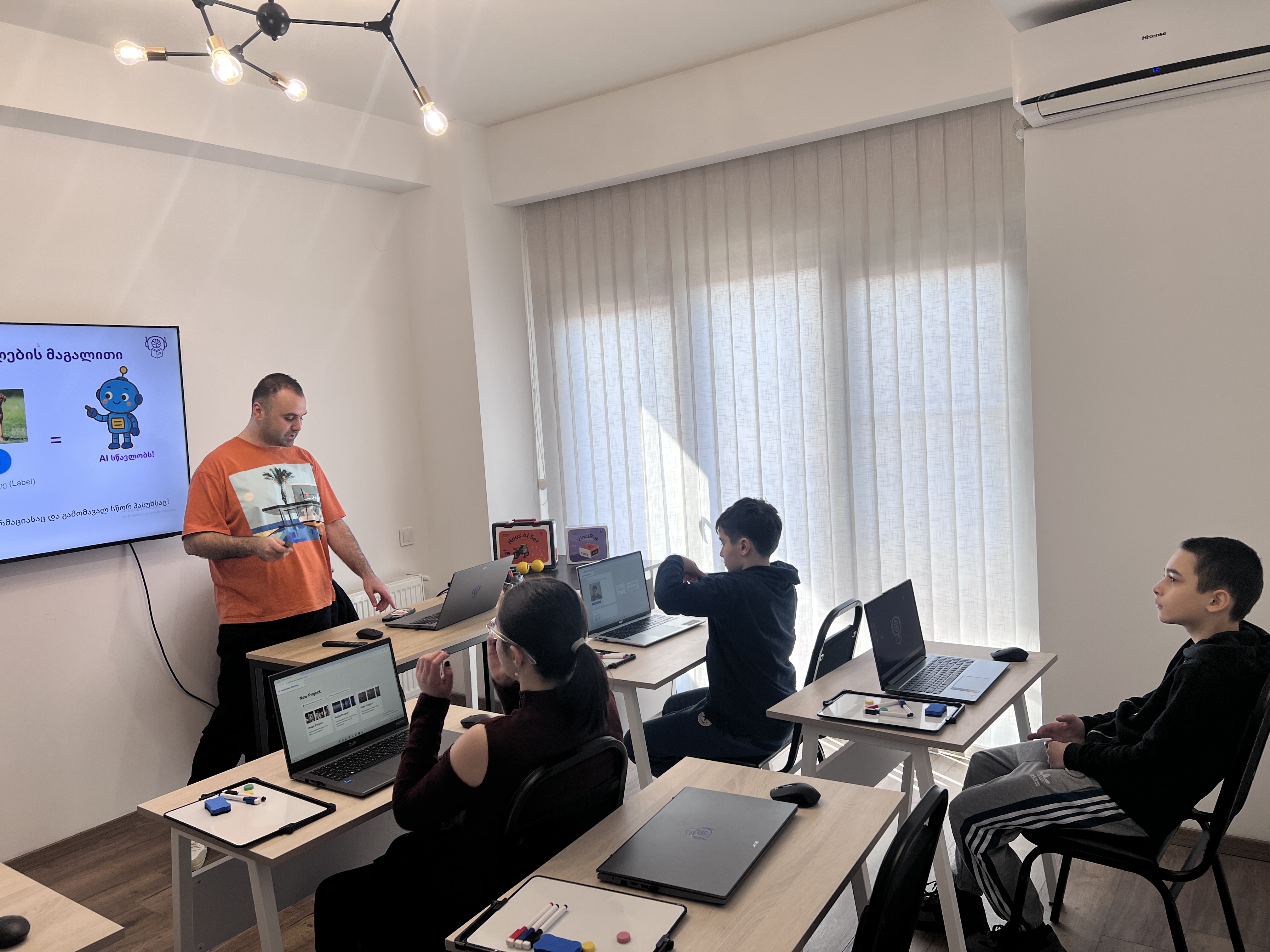
"Understand AI"
17 lessons · Ages 8–12 · Screen-based · Once per weekFor children who love asking questions and thinking about big ideas. Builds deep AI literacy — how it works, why it makes mistakes, how to use it responsibly.
"Build with AI"
Starts with robotics · Ends with AI · Ages 8+For children who love building and hands-on challenges. A real robot in their hands from day one — and in the final weeks, they train it to recognise their own voice.
You can attend both courses. Some students do just that. AI Literacy pairs perfectly with the hands-on robotics practice of VinciBot. It will teach your child both the fundamentals of AI and give them the joy that comes from coding real robots.

17 lessons · 8 units · Aligned with US national standards
Students go beyond buzzwords — learning how perception, algorithms, and data combine to make AI systems work.
Using Google Teachable Machine, students train their own image classifiers — the same workflow used by professionals.
Why AI makes mistakes, what algorithmic bias means, and how to use AI responsibly — critical thinking built in.
How language models work, why they hallucinate, and how prompt engineering shapes AI outputs.
What data AI systems collect, how it's used, and how to protect personal information in a digital world.
In the final lessons, students code a reinforcement learning agent in Scratch — seeing RL in action.
8 units · 17 lessons · each approx. 60 minutes
Ready to start? Limited spots available.
📄 Download Curriculum PDFStarts with robotics. Ends with AI.
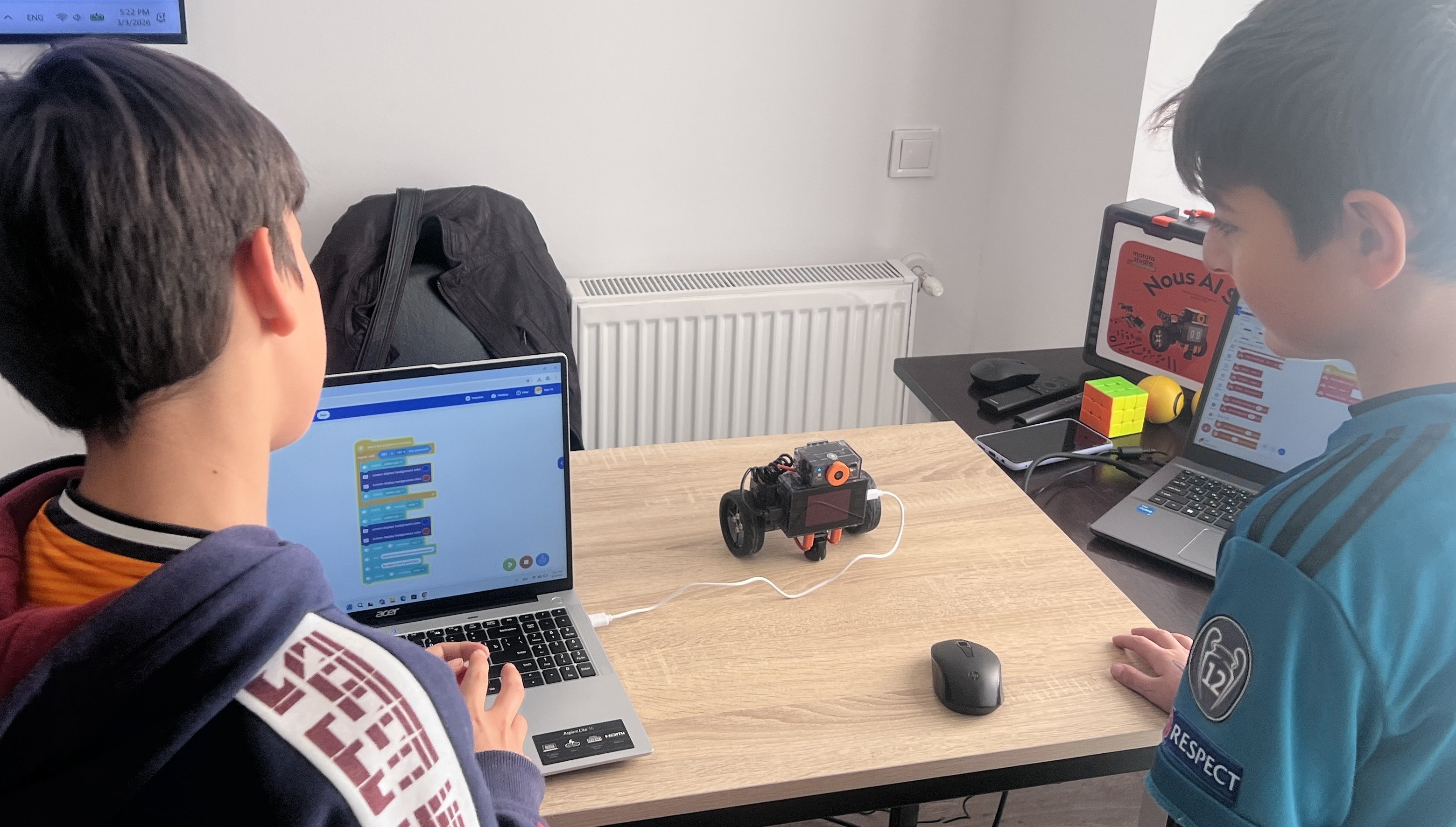
Students program VinciBot to move, draw, react to sensors, and build autonomous behaviors. The foundation every AI system needs.
Block coding · Sensors · Loops · EventsStudents collect data, train ML models directly on VinciBot, and deploy them. The robot learns from their voice. Real machine learning, on a real robot from early ages.
Tiny ML · Speech · Object recognition · IoTStudents physically program VinciBot to move, draw, navigate by sensors, and respond to its environment. 18 lessons of hands-on coding.
Students record voice commands, train a speech model, and deploy it. VinciBot responds only to their voice.
Using the ToF sensor, VinciBot learns to tell a book from a pen. Students collect the training data themselves.
Students train VinciBot to recognize handwritten letters using the ToF sensor. Students train the model from scratch.
VinciBot connects to Wi-Fi for real-time data. Multiple robots can communicate and dance together.
Students can qualify for the MWRC — an international robotics competition where children compete against teams from around the world.
What your child does and learns, lesson by lesson
| Lesson | Topics Covered |
|---|---|
| ▸ PART 1 — Coding & Robotics (Lessons 1–18) | |
01. Program VinciBot | Block codingSequencesRobot movement |
02. Multi-talented VinciBot | LED matrixSound & lightLoops |
03. Event Coding Blocks | EventsTriggersInteractive programs |
04. VinciBot Loves to Draw | Drawing modeGeometryCoordinates |
05. Candy Collecting | LoopsRepetitionGame logic |
06. Multi-threading | Parallel tasksConcurrent execution |
07. VinciBot is Responsive | SensorsConditionalsIf/else logic |
08. Light-on Reminder | Infrared sensorReal-world automation |
09. Make a Block for VinciBot | FunctionsCustom blocksCode reuse |
10. Coward VinciBot | Obstacle avoidanceDistance sensor |
11. Spiral Graphics | VariablesMath in codePatterns |
12. Marathon | TimerVariablesGame design |
13. Catch 3! | Game logicScoringUser interaction |
14. Speed Change by Color | Color sensorVariable speedSensor-driven behavior |
15. Smart Cruise | Autonomous navigationMulti-sensor logicFunctions |
16. Light Chaser | Nested if/elseLight sensorAutonomous steering |
17. Heart to Heart | Infrared communicationColor sensorTwo-robot interaction |
18. Line Following | Line following sensorMotor controlAutonomous navigation |
| ▸ PART 2 — This is Where Robotics Becomes AI (Lessons 19–23) | |
19. Listen, VinciBot! | Tiny MLSpeech modelVoice commands |
Ext. Vinci Pet | Custom speech modelModel deployment |
20. Book or Pen | ToF object recognitionData collectionML training |
21. VinciBot Recognizes Letters | Letter recognitionHandwriting AI |
22. What is the Weather? | IoTWi-FiReal-time data |
23. Let's Dance! | IoT broadcastingMulti-robot controlGroup coordination |
Ready to put a real AI robot in your child's hands?
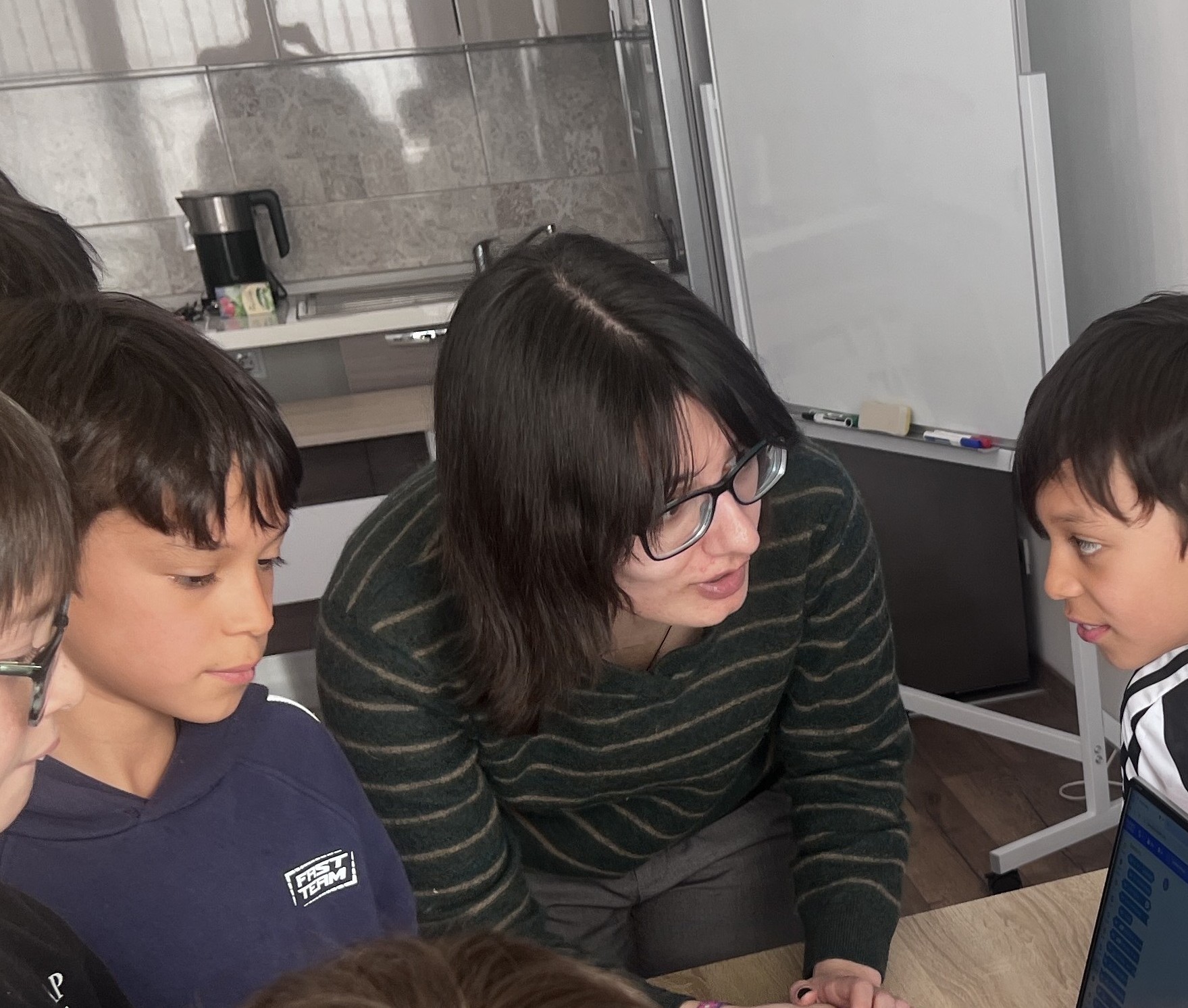
Enroll in VinciBot →Small groups mean your child works closely with their instructor every lesson.
BSc in Mathematics (Ilia State University), dual Master's in Education Administration (SEU) and Information Technology (Czech University of Life Sciences), Erasmus exchange alumnus. Actively involved in international education programs — teaching and leading projects across Poland, Croatia, Czech Republic and Georgia. Believes that when a child grasps a new idea and starts asking their own questions, it stops being just learning — it becomes a process of discovering the world. Finds AI education particularly compelling because it brings together logic, creativity and thinking about the future.
Studying Computer Science & Mathematics at Free University of Tbilisi with a strong foundation in AI and machine learning. Has been tutoring since 2023 and has taught in the English sector of a Tbilisi private school — gaining real insight into classroom dynamics, student engagement, and what it means to be a responsible educator. Believes AI can be a powerful learning tool, but only when students are guided properly. This motivates her to teach students not only subject matter, but also how to think critically, learn independently, and use modern tools responsibly.